
Where Pakistan stands on crypto
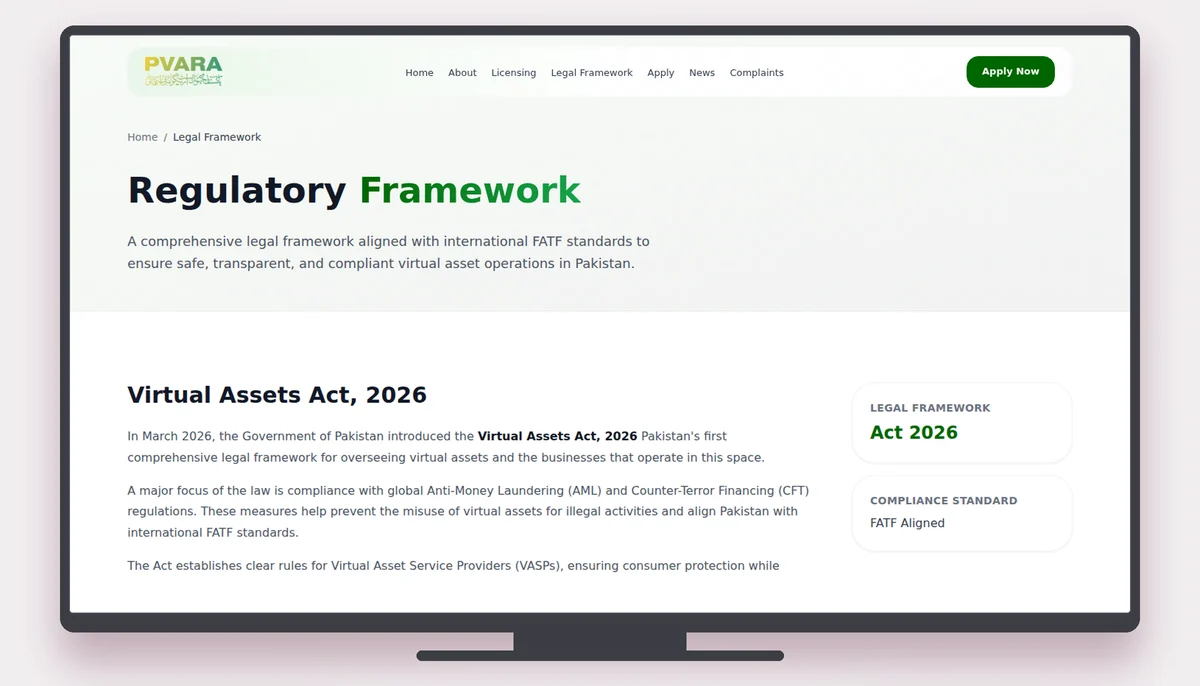
The legal framework for virtual assets in Pakistan has been changing, and new rules and a new authority may have been set up. This page does not assert which law or authority is in force, any date, or whether any venue is permitted. The reader should check the State Bank, the SECP and any virtual-assets authority on their own pages for the present position. The questions below are the ones to ask any venue.
What the law has been
In the past, the State Bank of Pakistan and the SECP issued statements on virtual assets. Those statements may have been replaced or amended. This site does not state which law is in force today. The reader should check the State Bank's own pages for its present position on virtual assets and the SECP's pages for any rules on digital tokens.
The law may have changed recently. A new authority for virtual assets may have been set up, and it may have published its own rules. The reader should look for that authority's website and read what it says. This page describes the questions to ask, not the answers.
What to ask a venue: its legal entity
Every platform that offers crypto services has a legal entity behind it: a company registered in some country. Ask the platform for the name of that legal entity and the country where it is registered. A platform that will not name its legal entity has not answered the first question. The legal entity is the party you would sue if something went wrong.
The legal entity's name can be checked on the company register of its home country. That register will show whether the company exists and who its directors are. It will not show whether the company is permitted to offer crypto services in Pakistan. For that, you need the home regulator.
What to ask a venue: its home regulator
Ask the platform which regulator authorises it in its home country. The regulator's name should be specific: not just 'the financial authority' but the actual body. Then go to that regulator's own register and search for the legal entity. The register will show whether the entity is authorised and what activities it is permitted to carry on.
A platform may be authorised for some activities but not for crypto. The register will say. A platform may claim to be regulated but the register may show no such authorisation. The reader should not send money to a platform whose authorisation cannot be found on the regulator's own register.
What to ask a venue: its complaint route
Ask the platform what happens if you have a complaint. Which person or body do you write to? In which country? What is the procedure and how long does it take? A platform that has no complaint route has not answered the question. The complaint route should be in writing and should lead to a named person or body.
The home regulator may have its own complaint channel for consumers. Check that channel. If the platform is authorised, the regulator may be able to help. If the platform is not authorised, the regulator may warn you. The complaint route is part of the platform's answer to the question 'who is accountable?'
What the State Bank and the SECP say today
The State Bank of Pakistan has published statements on virtual assets in the past. The SECP has also published statements. Those statements may have been updated. This site does not quote them because they may have changed. The reader should go to the State Bank's own website and the SECP's own website and read what they say today.
There may be a new virtual-assets authority. It may have its own website. The reader should look for it. The authority's register, if it has one, may list permitted venues. The reader should check that register before dealing with any venue. The present position is on the official pages, not on this site.
What a Pakistani reader should do
Before dealing with any crypto venue, write down the three questions: what is your legal entity, which regulator authorises you at home, and what is your complaint route. Ask the venue in writing. Keep the answers. Then check the answers on the regulator's own register. If the answers do not match, do not send money.
The law in Pakistan may change again. A venue that is permitted today may not be permitted tomorrow. The reader should check the official pages before each transaction. The risk of losing money is real, and no check on this site can remove it. The reader decides.
Why a crypto venue may not be the same as its marketing name
A trading site often runs on a name that is not a legal entity. The website may say 'XYZ Exchange', but the company that actually takes the deposit could be registered under a different name in a different country. The terms page may list an operating company that has no obvious link to the brand shown on the home page. This matters because any complaint or claim must be directed at the legal person, not the brand.
Ask the venue to name the exact legal entity that will hold your funds. Then ask for that entity's registration number and its registered address. If the answer is vague or points to a shell company in an unrelated jurisdiction, the brand itself gives you no one to sue. A platform can change its trading name without changing the underlying entity, so a familiar name is not evidence of a stable counterparty.
The legal entity also determines which insolvency or compensation arrangements might apply. A venue that uses an entity in a jurisdiction with no investor-protection scheme leaves you with no statutory fallback. The brand name is what you see in advertisements, but the legal entity is what matters in a dispute. Always separate the two before sending money.
The difference between a ban on dealing and a ban on offering
Pakistan's rules have often been read as a blanket ban on crypto, but the wording matters. A regulator may prohibit banks and payment companies from processing crypto transactions, while not directly criminalising an individual who holds or trades crypto. A separate rule may bar platforms from offering services to residents, while leaving the resident's own act unpunished. These are different legal questions, and they lead to different risks.
A ban on dealing means the financial institution cannot move your money to a crypto venue. If you try anyway, the bank may freeze your account or report the transaction. A ban on offering means the platform commits an offence by marketing to you, but you may not be the person the law targets. However, if the platform is offshore, the ban on offering is hard to enforce, and you may still lose your money without any local remedy.
The practical result is that you may face no criminal penalty for buying crypto, but you also have no legal protection if the platform disappears. The bank's refusal to process a payment is not a statement that the platform is a fraud; it is the bank complying with a directive. Knowing which act is banned helps you predict where the loss will fall if something goes wrong.
What happens when the platform's home regulator has no power over Pakistan
A venue may be registered with a financial regulator in another country, but that regulator's reach stops at its own border. If the platform is licensed in a small offshore centre, that licence does not authorise it to take Pakistani clients, and the regulator will not hear a complaint from a Pakistani resident. The licence is a fact about the home country, not a promise of protection for you.
Ask the venue what its home regulator can do for a client in Pakistan. If the regulator's website says it does not accept complaints from foreign residents, or that its compensation scheme covers only domestic clients, then the licence gives you little. Some regulators publish warnings that their licensees may not offer services abroad without local authorisation. A platform that ignores such warnings is already operating outside its own licence.
The safest assumption is that a foreign licence is irrelevant to your claim unless the regulator explicitly covers cross-border clients. Even then, the cost of pursuing a complaint in a foreign language and legal system may exceed the amount lost. The home regulator's existence is a starting question, not a guarantee. Always ask what that regulator actually does for someone in your position.
Why a platform's own terms can erase the complaint route it advertises
Many platforms show a complaints email or an online form, but their terms of service may quietly send disputes to arbitration in a country you have never visited. The terms may say that the law of a particular offshore island governs the contract, and that any claim must be brought in its courts. What looks like a complaint route is really a path to a jurisdiction where you cannot afford to go.
Read the dispute-resolution clause before you deposit. If it names a foreign arbitration body and requires you to pay half the arbitrator's fees upfront, the advertised complaints address is meaningless. Some terms even waive your right to join a class action or to seek compensation from a local court. The platform is not hiding the route; it is making the route impractical.
A complaint route only matters if it leads to a decision that the platform will obey. If the platform is not a member of any ombudsman scheme and has no assets in the jurisdiction where you could enforce a judgment, the route is decorative. Ask what happens after the complaint is decided: who pays, and how the decision is enforced. Without an enforcement mechanism, a complaints page is just text.
How the State Bank's rules on remittance change what a crypto payment looks like
When you send money to an overseas crypto platform, you are making a cross-border payment. The State Bank's rules require such payments to go through an authorised dealer, usually a bank, and to be for permitted purposes. The bank must ask what the payment is for and may demand an invoice or a contract. If you say it is for buying crypto, the bank will likely refuse, because the purpose is not on the permitted list.
The refusal does not mean the platform is unsafe or illegal; it means the bank cannot process that payment under its licence. If you try to bypass the bank by using an informal money transfer, you lose the protection of the authorised-dealer framework. The person who takes your rupees may never deliver the foreign currency to the platform, and you have no record the State Bank will recognise.
The practical question is not whether the platform accepts your money, but whether the payment channel itself is lawful. A platform that suggests using a third-party money changer or a peer-to-peer transfer is asking you to step outside the regulated remittance system. That step may expose you to criminal liability under foreign-exchange laws, even if the platform itself is registered somewhere. The payment method, not just the platform, determines your legal exposure.
What this page records
Read next
Questions on crypto and networks
Is crypto legal in Pakistan?
The legal framework has been changing, and new rules and a new authority may have been set up. This site does not assert which law or authority is in force. Check the State Bank, the SECP and any virtual-assets authority on their own pages for the present position.
What is a legal entity?
It is the company behind the platform, registered in some country. Ask the platform for the name of that legal entity and the country where it is registered. A platform that will not name its legal entity has not answered the first question.
How do I check a home regulator?
Ask the platform which regulator authorises it in its home country. Then go to that regulator's own register and search for the legal entity. The register will show whether the entity is authorised and what activities it is permitted to carry on.
What is a complaint route?
It is the procedure for making a complaint: which person or body you write to, in which country, and how long it takes. Ask the platform in writing. The home regulator may also have its own complaint channel for consumers.
What should I do before dealing with a crypto venue?
Write down the three questions: legal entity, home regulator, complaint route. Ask the venue in writing. Check the answers on the regulator's own register. If the answers do not match, do not send money. Check official pages before each transaction.
What opening an account means
A CFD account with an overseas broker is a legal agreement, not a registration with a Pakistani exchange. Before you open one, read the client agreement and the risk warning, and check the broker's legal entity and home regulator on its own register.