
How a lawful direct-selling business differs from a pyramid
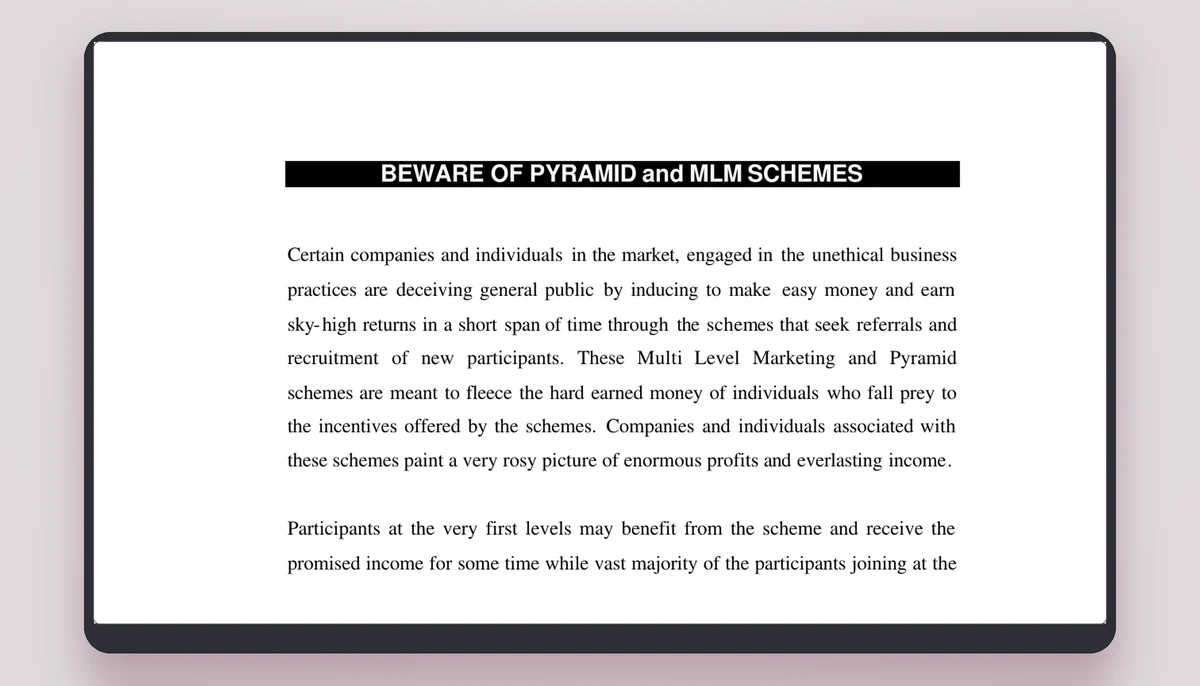
A lawful direct-selling business pays for selling real products to real customers. A pyramid pays for enrolling others. The SECP, as corporate registrar, has published notices on schemes in the past, but this page states no rule numbers. A company incorporated with the SECP has not thereby been permitted to take investments.
What a lawful direct-selling business is
A lawful direct-selling business sells real products to real customers. The seller earns a margin on the products sold. The seller may also earn a commission on sales made by people the seller recruited. But the commission is based on product sales, not on the act of recruiting. The product has value apart from the scheme.
The key is that money comes from customers buying products. If no products are sold, no one earns anything. The business can continue even if no new sellers are recruited. The products are real and are delivered. The price is not inflated to pay for recruitment.
What a pyramid is
A pyramid pays for enrolling others. The money comes from the entry fees of new recruits. The product, if any, is a cover. The price of the product is inflated so that part of it can be paid to the recruiter. The product may never be delivered, or it may be worthless. The scheme depends on an endless chain of new recruits.
A pyramid must collapse because there are not enough people to keep enrolling. The people at the top make money; the people at the bottom lose everything. The SECP has published notices on schemes in the past. This page states no rule numbers, but the distinction is in the payment structure.
What SECP incorporation means
A company incorporated with the SECP has been registered as a company. That is all. Incorporation does not mean the company may take investments from the public. It does not mean the company's scheme is lawful. It does not mean the SECP has approved the company's products or business model.
The SECP is the corporate registrar. It registers companies. It also publishes investor alerts and notices on schemes that appear to be taking investments unlawfully. A company that is incorporated may still be running a pyramid. The reader should check the SECP's alerts and ask the company hard questions.
How to tell the two apart
Ask the company: where does the money come from? If the money comes from selling products to customers who are not participants, the business may be lawful. If the money comes from entry fees paid by new participants, the business is a pyramid. Ask what happens if no one new joins: does the business still pay?
Ask to see the product. Is it real? Is it delivered? Is the price reasonable compared to similar products in the market? If the product is a token, a course, or a digital item with no independent value, be careful. The answer to 'where does the money come from' is the test.
What the SECP has published
The SECP has published notices on schemes in the past. Those notices may name companies or describe schemes. This page names no company and states no rule numbers. The reader should go to the SECP's own website and read the investor alerts. The alerts are the SECP's own words.
The SECP's alerts are a warning, not a verdict. A company named in an alert may still be operating. The reader should read the alert and decide. The SECP's incorporation register shows whether a company exists; it does not show whether the company's scheme is lawful.
What to do before joining a scheme
Before joining any network marketing scheme, ask the company for its legal entity and its SECP incorporation number. Check the incorporation on the SECP's register. Then ask the company the key question: where does the money come from? Get the answer in writing.
Read the SECP's investor alerts. If the company or a similar scheme is named, be careful. Do not pay an entry fee until you understand the payment structure. A lawful direct-selling business pays for sales; a pyramid pays for recruitment. The reader decides.
A direct seller does not earn from the recruits she brings in
In a lawful direct-selling business, the seller's income comes from the goods she actually sells to customers. The company may pay a small bonus for training or supporting other sellers, but that bonus is not the main source of anyone's income. The product price is set by the company, and the seller earns a margin or commission on each sale.
A pyramid flips this order. The person who joins is told the real money is in bringing others under her, not in selling the product. Each new recruit pays a fee or buys a starter kit, and a slice of that payment moves up the line. The product becomes a formality, often overpriced and hard to sell to anyone outside the scheme.
The test is simple to apply in Pakistan. Ask the person recruiting you what she earned last month from her own sales to customers who are not members. If she cannot show that figure, or if her main income is from her downline's joining fees, the structure is a pyramid. A lawful business does not depend on an endless chain of new joiners.
The company's refund policy shows which structure it is running
A lawful direct-selling firm in Pakistan usually offers a cooling-off period and a clear refund policy for unsold inventory. The seller who leaves can return products she did not sell and get her money back, minus a small restocking charge. This is not a favour; it is a sign the company expects to make money from sales to end customers.
A pyramid has no real refund policy, because the product is not meant to be returned. The joining fee or the forced starter kit is the revenue. When a seller asks to leave and return her stock, she is told the deadline has passed, or that the products were 'activated' and cannot be returned, or that she should find a new recruit to buy her kit.
Before joining any scheme in Pakistan, ask for the refund policy in writing. Then test it: ask what happens if you want to leave after one month with unsold products. If the answer is vague, conditional on recruiting someone else, or simply absent, the structure is designed to trap your joining fee. A lawful business can survive customers returning products; a pyramid cannot.
SECP incorporation does not approve the business model
When a company is incorporated with the Securities and Exchange Commission of Pakistan, the SECP is recording that the company exists and has filed its documents. The certificate of incorporation is not a licence to run a direct-selling scheme, and it is not a finding that the scheme is lawful. The SECP itself has warned that many pyramid schemes operate through incorporated companies.
The confusion arises because an incorporated company looks official. It has a registration number, a registered office, and directors. But every company in Pakistan, from a corner shop to a listed firm, has those same features. The registrar does not examine the compensation plan, the product pricing, or the recruitment structure before issuing the certificate.
So when a promoter shows you an SECP incorporation certificate and says the business is approved, that is a misuse of the document. The correct question is not 'is the company incorporated?' but 'has any regulator approved this compensation plan as a lawful direct-selling model?' In Pakistan, no regulator gives a general stamp of approval for such plans.
The joining fee is the first diagnostic
A lawful direct-selling company may charge a small fee for a starter kit or for training materials. But that fee is modest, and it is refundable if you leave the business within the cooling-off period. The company's income does not depend on the joining fee; it depends on the ongoing sale of products to customers.
A pyramid scheme, on the other hand, lives on the joining fee. The fee is often large, and it is presented as an 'investment' or as a purchase of a 'business package'. The recruiter's main task is to collect that fee from as many people as possible, because a portion of it flows up the line. The product is secondary.
In Pakistan, ask the recruiter exactly what the joining fee pays for, and ask whether it is refundable. If the fee is large relative to the value of the products you receive, or if the refund conditions are onerous, the scheme is likely a pyramid. A lawful business does not need a large entry fee because it earns from product sales, not from new members.
The promoter's documents reveal the compensation structure
Every direct-selling company has a compensation plan, whether written or not. A lawful plan shows how a seller earns from her own sales and from the sales of people she personally supervises, with clear limits on how many levels deep she can earn. The plan is public, understandable, and does not promise income from merely recruiting.
A pyramid scheme's compensation plan is often complex, with many levels, binary legs, and bonuses for hitting recruitment targets. The plan may be hidden or explained only in private meetings. The emphasis is on building a downline, not on selling products. The plan rewards the act of bringing in new people, which is the defining feature of a pyramid.
Before joining any scheme in Pakistan, ask for the written compensation plan and study it. If the plan rewards you for enrolling others, regardless of what they sell, that is a pyramid. If the plan pays you only on product sales, and the recruitment bonuses are small and capped, the scheme may be lawful. But the plan itself is the best evidence of the structure.
The company's own register of members is what a court will read first
A lawful direct-selling business keeps a register of members that shows who actually owns and controls the company. The register is not a marketing brochure; it is a statutory record that the company must maintain under the Companies Act. When a dispute reaches a court, this register is one of the first documents the judge will call for. It records the name, address, shareholding, and date of becoming a member for each person. If the register is not kept or is filled with nominee names that lead nowhere, the court will notice.
The practical consequence is that a person who joins a direct-selling scheme should ask to see the register of members, not the marketing plan. A company that refuses to show the register, or shows one that has been updated only once, is signalling that its ownership structure is not meant to be examined. The register should show changes over time: new members entering, old members leaving, and the transfer of shares. A register that never changes while the company claims to be expanding is a red flag that a reader can verify without any special skill.
A further check is to compare the register with the list of directors filed with the SECP. The two records are not the same thing, and they are kept for different purposes, but they should be consistent. If the register shows one set of controllers and the SECP filing shows another, the company has failed to update at least one of them. That failure is not proof of a pyramid, but it is a failure to comply with the law, and it means the reader cannot rely on any other record the company produces.
What this page records
Read next
Questions on crypto and networks
What is the difference between direct selling and a pyramid?
Direct selling pays for selling real products to real customers. A pyramid pays for enrolling others. The money in a pyramid comes from entry fees, not product sales. The product, if any, is a cover.
Does SECP incorporation mean the scheme is lawful?
No. Incorporation means the company is registered. It does not mean the company may take investments or that its scheme is lawful. The SECP has published notices on schemes in the past. Check the SECP's alerts.
What question should I ask a scheme?
Ask where the money comes from. If it comes from selling products to customers who are not participants, the business may be lawful. If it comes from entry fees paid by new participants, it is a pyramid.
What if the product is digital?
Be careful. A digital product may have no independent value. If the price is inflated to pay recruiters, the scheme is a pyramid. Ask what happens if no one new joins. A lawful business continues; a pyramid collapses.
What should I do before joining?
Ask for the legal entity and SECP incorporation number. Check the incorporation. Ask where the money comes from. Read the SECP's investor alerts. Do not pay an entry fee until you understand the structure.
What opening an account means
A CFD account with an overseas broker is a legal agreement, not a registration with a Pakistani exchange. Before you open one, read the client agreement and the risk warning, and check the broker's legal entity and home regulator on its own register.