
How State Bank rules bear on paying an overseas platform
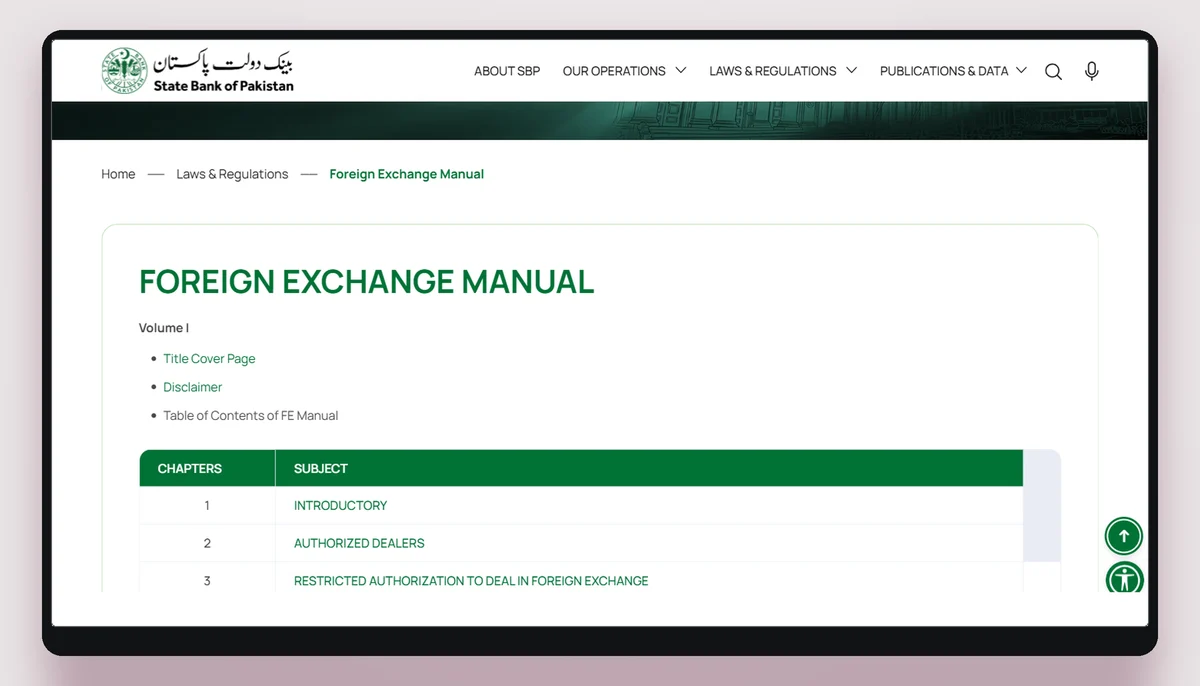
Payments abroad go through authorised dealers. A bank may ask for the purpose and documents. An informal route through a person has no protection. This page states no limits or amounts. The reader should ask their bank what purposes it can process. The bank is the gatekeeper.
What an authorised dealer is
An authorised dealer is a bank or other institution licensed by the State Bank of Pakistan to deal in foreign exchange. When you send money abroad, the payment goes through an authorised dealer. The dealer must follow the State Bank's rules. The dealer may ask you for the purpose of the payment and for documents that show the purpose is genuine.
The dealer is not your adversary. The dealer is the gatekeeper that the State Bank holds responsible. If the dealer processes a payment that breaks the rules, the dealer may be penalised. So the dealer will ask questions. The reader should answer truthfully and keep copies of what was sent.
What the bank may ask for
The bank may ask for the purpose of the payment. It may ask for documents: an invoice, a contract, a fee note, or other papers that show why you are sending money. The bank may ask for the identity of the recipient and the country. The bank may refuse if the purpose is not one that the State Bank permits.
The bank's questions are not arbitrary. They come from the State Bank's rules. The reader should ask the bank what purposes it can process and what documents it needs. The bank will tell you. If the bank says a purpose is not permitted, do not try to route the payment through an informal channel.
Why an informal route has no protection
An informal route through a person—a friend, a relative, a money changer who is not an authorised dealer—has no protection. The State Bank's rules apply to authorised dealers, not to informal transfers. If the money is lost, there is no regulator to complain to. The person who took the money may disappear.
The informal route may seem cheaper or faster. It is not safer. The reader should use an authorised dealer for any payment abroad. If the bank will not process the payment, the reader should ask why and what alternative is lawful. The bank's answer is the one to follow.
What the State Bank permits
The State Bank publishes rules on foreign exchange. Those rules say what payments may be made abroad and through which channels. The rules may change. This site does not state the current rules because they may have changed. The reader should check the State Bank's own website for the present position.
The reader should also ask their bank. The bank is the authorised dealer and knows the rules as they apply to the reader's situation. The bank may say that a payment to an overseas platform for trading is not permitted. The reader should accept that answer and not try to find a way around it.
What to do before paying an overseas platform
Before paying an overseas platform, ask the platform for its legal entity and home regulator. Check that regulator's register. Then ask your bank whether the payment can be processed. The bank may ask for the platform's details and the purpose. The bank may say no.
If the bank says no, do not use an informal route. The informal route has no protection, and the platform may still take your money. The reader should consider whether the platform is worth the risk. The bank's answer is a signal about the lawfulness of the payment.
What the bank's refusal means
A bank's refusal to process a payment is not a punishment. It is the bank following the State Bank's rules. The bank may refuse because the purpose is not permitted, because the documents are incomplete, or because the recipient is on a list. The bank may not tell you the exact reason.
The reader should ask the bank what alternative is lawful. If there is no lawful alternative, the reader should not send the money. The risk of losing money through an informal route is real. The bank is the gatekeeper, and its refusal is a signal to stop and think.
A bank can reject a payment without saying the platform is unlawful
A refusal from a bank does not mean the State Bank has ruled against the platform. Banks set their own compliance policies and may decline a transaction that they cannot easily match to a permitted purpose. They may also refuse when the receiving account is not with a recognised financial institution. The refusal is a business decision by the bank, not a finding by the regulator.
The bank may not tell the customer the full reason. It could be that the payment details triggered a routine check, or that the bank has paused all transfers to a particular country or payment method. The customer is left without a clear explanation. That uncertainty should not be read as a signal that the platform is unsafe or illegal.
What the customer can do is ask the bank to confirm in writing whether the payment was blocked by the bank's own policy or by a State Bank directive. Banks are required to follow State Bank rules, but they also have discretion. Knowing which one applied helps the reader decide whether to try another bank or to ask the platform for a different payment route.
Paying through a money transfer operator is still a foreign exchange transaction
Some readers assume that using a money transfer operator, a wallet service, or a payment gateway avoids the State Bank rules. It does not. Any movement of funds from Pakistan to an overseas recipient is a foreign exchange transaction, no matter which intermediary is used. The rules apply to the customer and to the intermediary.
Money transfer operators are also authorised dealers or work through them. They must follow the same purpose codes and reporting requirements as a bank. If a transfer operator accepts a payment that a bank would refuse, that does not make the payment compliant. It may simply mean the operator has weaker controls or a different risk appetite.
The customer remains responsible for the accuracy of the information given to the transfer operator. If the payment is later questioned, the customer cannot claim ignorance of the rules. The same question should be asked of any channel: does this payment fit a purpose the State Bank permits for an individual sending money abroad?
The State Bank's rules do not cover the platform's side of the transaction
The State Bank regulates what leaves Pakistan, not what happens to the money after it arrives overseas. A platform may be licensed in another country, or it may operate without any licence at all. The State Bank's permission to send funds abroad does not amount to an endorsement of the platform receiving them.
The customer often confuses two questions. The first is whether the payment can be made under Pakistan's foreign exchange rules. The second is whether the overseas platform is allowed to offer its services to someone in Pakistan. These are separate questions, answered by different regulators in different countries.
A bank that processes the payment is not vouching for the platform. The bank is only confirming that the outward remittance meets the State Bank's requirements. Any later problem with the platform, such as loss of funds or refusal to return money, is outside the bank's control and outside the State Bank's remit.
A refusal by one bank does not mean all banks will refuse
Banks in Pakistan do not all apply the State Bank's rules with the same strictness. One bank may ask for extensive documentation, while another may process the same payment with fewer questions. This difference is not a loophole; it reflects each bank's internal compliance policy and its reading of the rules.
A customer who is refused by one bank sometimes tries another bank and succeeds. That success does not mean the payment was unlawful at the first bank and lawful at the second. It means the second bank assessed the same transaction differently. The State Bank's underlying rules have not changed.
Trying multiple banks can be a way to test how the rules are being applied, but it also creates a record of repeated attempts. If the payment is later reviewed, the customer may be asked why they tried so many channels. The better approach is to understand the reason for the first refusal before looking for another bank.
The purpose code on the remittance form determines how the bank treats the payment
Every outward remittance from Pakistan is tagged with a purpose code that tells the State Bank what the money is for. The code the customer selects, or the one the bank selects based on the customer's description, decides which set of rules applies. Choosing the wrong code can lead to a refusal or to the payment being reported for the wrong reason.
The customer may be asked to describe the payment in their own words, and the bank then picks the code. If the description is vague, the bank may pick a restrictive code or ask for more detail. The customer should be precise about what the money is buying and who the ultimate recipient is.
The purpose code is not a way to hide the nature of the payment. The State Bank can see the code and the amount together. A payment described as something routine when it is actually for a speculative platform will stand out if the amount or the recipient pattern changes. The code is a disclosure, not a disguise.
A platform that turns away Pakistani cards is not necessarily a red flag
Some overseas platforms stop accepting payment cards issued in Pakistan even though the platform itself keeps operating elsewhere. The refusal often comes from the platform's payment processor, which applies its own country rules rather than any instruction from the State Bank. That means the platform may still accept Pakistani users through other channels, while the card route simply closes.
A reader can misread this as the State Bank blocking the platform by name. In practice the regulator does not publish a list of blocked overseas merchants; it sets conditions on authorised dealers and payment gateways. Those intermediaries then choose which transactions to process, and their choices may vary from one bank to another or from one month to the next.
The practical question is therefore narrower than 'is this platform banned'. It is whether any Pakistani payment route remains open, and what the platform itself suggests when a card fails. A platform that quietly encourages a workaround, such as a foreign-issued card or a third-party wallet, is asking the user to step outside the protections that a Pakistani bank would otherwise provide.
A successful payment does not settle the legal question
A bank may process an overseas payment without asking for any document beyond the standard remittance form. That silence is not an approval of the platform's business, nor is it a finding that the activity is lawful for a Pakistani resident. The bank has checked the payment against the foreign exchange rules and found no reason to stop it; it has not checked the platform's underlying offer.
The State Bank's supervision runs to the movement of money, not to the merchant's product. So a payment that goes through can later sit inside a transaction that the tax authorities or the SECP view differently. The reader who treats a successful transfer as a green light is joining two questions that the regulators deliberately keep apart: whether the money may move, and whether the activity may be offered.
This is why the page separates the payment step from the registration step. A platform can be absent from every Pakistani register and still receive a lawful remittance for an import or a service. A platform can also appear on a foreign register and still fall outside what the State Bank permits Pakistani residents to buy. The payment receipt answers only the first of those questions.
What this page records
Read next
Questions on crypto and networks
What is an authorised dealer?
It is a bank or other institution licensed by the State Bank to deal in foreign exchange. Payments abroad go through authorised dealers. The dealer must follow the State Bank's rules and may ask for the purpose and documents.
What documents might the bank ask for?
The bank may ask for an invoice, a contract, a fee note, or other papers that show the purpose of the payment. The bank may also ask for the identity of the recipient and the country. Ask the bank what it needs.
Why should I not use an informal route?
An informal route through a person has no protection. The State Bank's rules apply to authorised dealers, not to informal transfers. If the money is lost, there is no regulator to complain to. Use an authorised dealer.
What if the bank refuses to process my payment?
Ask the bank why and what alternative is lawful. The bank's refusal is a signal about the lawfulness of the payment. Do not use an informal route. Consider whether the platform is worth the risk.
Where can I find the State Bank's rules?
On the State Bank's own website. The rules may change, so check the present position. Also ask your bank, which is the authorised dealer and knows the rules as they apply to you.
What opening an account means
A CFD account with an overseas broker is a legal agreement, not a registration with a Pakistani exchange. Before you open one, read the client agreement and the risk warning, and check the broker's legal entity and home regulator on its own register.